Deborah Birx in Conversation with Toby Cosgrove: Four Ways AI Will Transform Healthcare
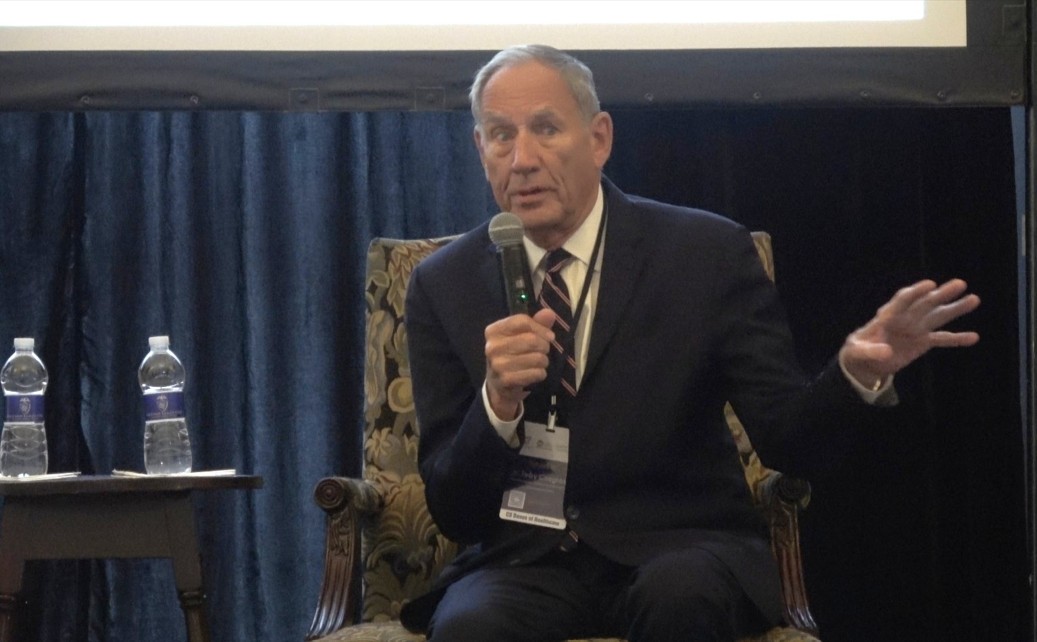
Celebrity Media: Dr. Deborah Birx, former White House Coronavirus Response Coordinator, yesterday held a conversation with Dr. Toby Cosgrove, former president and chief executive officer of Cleveland Clinic, on the pressures now facing health-care providers and how artificial intelligence can help the health-care system meet challenges such as rising costs, workforce shortages and the rapid growth of medical knowledge.
The conversation was held at New York's historic Union League Club. Founded in 1863, the club has long been an important place for leaders in American public affairs, including politics, business and medicine, to exchange views.
In the conversation, Birx looked back on her 29 years of military and medical work. She noted that medical professionals in the past did not always give enough attention to patients' emotional needs, and less often thought about problems from the standpoint of the pressures borne by health-care providers. She therefore asked Cosgrove: what pressures do medical institutions and health workers face today, and what role can artificial intelligence play?
Cosgrove said the challenges now facing the health-care system can be grouped, broadly, into three areas.
The first is financial pressure. The operating costs of hospitals and medical services continue to rise, and quite a number of U.S. hospitals are running at a loss. The second is a shortage of health-care workers, with a large number of unfilled posts in the sector. The third is the explosive growth of medical knowledge. Cosgrove pointed out that medical knowledge is being updated extremely quickly, that a huge number of medical papers are published each year, and that it is increasingly difficult for health professionals to keep up with all new research and clinical information by individual effort alone.
Faced with these pressures, Cosgrove believes that artificial intelligence can help health care at four levels.
First, artificial intelligence will further promote the spread of medical knowledge. The public will be able to obtain and understand health information more easily, and form a preliminary understanding of their own problems before seeing a doctor. This will increase patients' ability to take part in medical decisions, and will also change the information relationship between doctors and patients.
Second, artificial intelligence can assist medical research. It can process large amounts of data, identify patterns, and help researchers find valuable leads more quickly, thereby raising the efficiency of research.
Third, artificial intelligence will play a role in clinical work. Cosgrove further divided clinical applications into two levels, knowledge and practice. In his view, artificial intelligence will not, in the short term, completely replace doctors in performing operations such as surgery, but it can help medical staff organize and apply the ever-growing body of medical knowledge, so that clinical judgment is supported by more complete information.
Fourth, artificial intelligence can improve the administrative management of medical institutions, including handling cumbersome day-to-day tasks, raising operational efficiency, and easing the burden of non-clinical work on medical staff.
Cosgrove believes that these applications can be expected to ease the pressure on health-care providers and bring patients better care. However, this shift will also have a certain impact on doctors and on the medical profession as a whole, because health workers will have to learn how to adapt to new technologies and ways of working.
He also pointed out that the medical industry often responds slowly to change, but the development of artificial intelligence is forming a driving force that is hard to ignore, pushing the health-care system gradually to integrate patient services, scientific research, clinical practice and administrative management.
It is worth noting that the group that adopts artificial intelligence earliest and fastest may not be hospitals or doctors, but ordinary members of the public who want to obtain medical knowledge. This means that the change AI brings to the health-care industry will come not only from inside institutions, but also from patients' and society's demand for more transparent and more efficient medical services.